20 Legit Flexible Side Hustles for Stay-at-Home Mums
Table Of Content
(No Experience + Work Quietly From Home)
I want to start with something most guides in this space don’t say.
Staying at home with young children is not “doing nothing.” It’s a full-time, unpaid role with no sick days, no lunch breaks, and no end to the working day. Adding a side hustle on top of that isn’t a small ask — it’s a real decision that deserves real information, not a glossy list of vague ideas with income claims that don’t hold up.
I study digital marketing, which means I spend a lot of time looking at how online income opportunities are positioned and marketed. And I can tell you: most “side hustles for mums” content is written to attract clicks, not to genuinely help. The $10,000/month headline gets the traffic. The realistic breakdown of what actually works — and when you can actually do it — rarely does.
So that’s what this is. Twenty side hustles that are genuinely flexible, legitimately quiet (important when someone’s napping), and realistic about what you’ll earn and when. I’ve included the ones I’d actually recommend to someone I know — and I’ve been honest about the ones that take time to build versus the ones you can start this week.
Before the List: What Actually Matters for Stay-at-Home Mums
Most side hustle lists ignore the constraints that make this uniquely difficult. So let me lay them out first, because they’ll explain why some options are on this list and others aren’t.
The quiet requirement is real. A side hustle that needs 45 minutes of uninterrupted phone calls is genuinely incompatible with life when you have a toddler. Every hustle here works either silently or with headphones — nothing that requires you to be on speaker, in a noisy environment, or performing for a room.
Time is fragmented, not blocked. School hours are the closest thing to a proper working window, but even then they’re shorter than people assume — especially with pickups, drop-offs, and everything in between. Nap times are 45–90 minutes on a good day. Evenings are real but limited. The best hustles here can pause and resume without losing momentum.
Income takes time to build. I’m going to say that clearly: most of the higher-earning options on this list take 3–6 months before they generate meaningful income. The ones you can earn from this week tend to pay less per hour. That’s not a bug — it’s the honest trade-off between speed and scale.
Honest note: The average side hustler in the US earns around $400–$1,200 per month according to consistent survey data. That’s a meaningful number — not life-changing on its own, but genuinely helpful for bills, savings, or a specific goal. Set that as your 6-month target, not the outlier headline.
Start This Week — No Experience Needed
These are the options I’d tell a complete beginner to try first. They require minimal or zero setup, pay quickly, and don’t need a portfolio, a CV, or any particular skill. They’re not the highest-paying options on the list, but they’re real money you can earn right now.
1. Sell Your Unused Stuff
Every house with children has a backlog of things that are no longer needed: clothes they’ve grown out of in three months, toys that held their attention for a fortnight, baby gear that takes up space in the hallway. That stuff has real value to other families.
Facebook Marketplace is my recommendation for larger items (furniture, prams, playmats) because local pickup means no shipping hassle and payment is often instant cash. Vinted is the go-to for children’s clothing — they handle shipping labels and the audience is actively looking for kids’ items. eBay is best for anything branded, collectable, or niche.
The earning potential isn’t unlimited — it stops when you run out of things to sell — but I’ve seen people clear £200–£500 in a single weekend from a house sort. And the habit of listing regularly (rather than charity-bagging everything) adds up to real money over a year.
- Where to start: Photograph 5 things today. List them on Facebook Marketplace or Vinted.
- Honest ceiling: One-off bursts of £50–£500. Not a recurring income stream.
2. Paid Research Studies and Surveys
I want to split this one in two, because the difference in pay is significant.
Prolific and User Interviews are paid academic and product research platforms. Studies on Prolific average £6–£10 per hour — dramatically better than standard survey apps — because they’re run by universities and tech companies who need quality responses from real people. User Interviews hosts one-on-one research sessions that pay $25–$150 each for 30–90 minutes of your time.
Standard survey apps — Swagbucks, Survey Junkie, InboxDollars — are real and legitimate, but the pay is in a different league. Expect £10–£30 per month of consistent use, not per session. They’re worth having on your phone as background income while you’re doing other things, but not as a primary earner.
Honest note: I include survey apps for completeness, not because they’ll change your financial picture. Prolific and User Interviews are the genuinely interesting options here.
- Sign up: prolific.com and userinterviews.com
- Best worked: During nap time or after kids are in bed
3. Cashback Apps
Rakuten, Ibotta, and Fetch Rewards are not exciting, but they are genuinely passive — you earn money on spending you’re already doing. Families with children spend a lot: groceries, school supplies, clothing, household items. Running cashback apps consistently adds up to £15–£60 per month without changing your spending at all.
From a marketing perspective, I understand exactly how these platforms work: brands pay for shelf visibility and purchase data, and they pass a portion of that to you as cashback. The model is transparent. The apps are legitimate. They just require zero effort to run, which means most people forget to use them consistently.
- Tip: Install Rakuten as a browser extension. It automatically alerts you when cashback is available at any store you visit online.
4. Data Entry (Clickworker, Appen)
This one is particularly good during nap times because it’s completely self-paced, requires no calls, and can pause and resume cleanly. Clickworker offers micro-tasks including data entry, image tagging, text creation, and website categorisation. Appen focuses on AI training data work and pays better — $14–$20/hr — but takes a few days to get approved.
Neither is a high-income option. But as something to run during the 45 minutes your youngest is asleep, earning £8–£14 is more useful than scrolling.
Build Once, Earn Repeatedly — The Passive Options
These take more upfront effort — often weeks or months before meaningful income arrives — but the return is genuinely passive. Once the product exists or the pin ranks, it earns without ongoing work. As someone who studies marketing, this is the category I find most interesting, because the economics are genuinely different from trading time for money.
5. Sell Digital Products on Etsy
This is the side hustle I’d recommend most strongly to a stay-at-home mum who has any creative ability and some time to build something during school hours. The model is simple: you create a digital file — a printable planner, a budget tracker, a kids’ activity sheet, a party invitation template — and list it on Etsy. Every time someone buys it, you earn. The file exists once; it can sell thousands of times.
The income potential is wide — from £20/month for a small shop to £5,000+/month for a well-established one. The key variable is whether you research what’s already selling before you create, and whether your designs are genuinely better than what’s there. eRank is a free tool that shows you which keywords and products are performing well on Etsy — use it before making anything.
I’d recommend starting with Canva‘s free plan. You don’t need design experience — many of the best-selling digital products are clean, simple, functional templates. A well-designed weekly meal planner or a kids’ reward chart can earn for years from a single afternoon of work.
The parenting niche has genuine search volume on Etsy: “toddler activity sheets”, “daily routine chart for kids”, “meal planner printable family of 4”. These are specific, high-intent searches from parents who are ready to buy.
- Start-up cost: £0. Etsy charges £0.16 per listing and takes 6.5% per sale.
- Best worked: School hours for creation, then fully passive once listed
6. Print-on-Demand
Redbubble and Printify let you upload designs onto mugs, t-shirts, tote bags, and wall art — they print and ship everything when orders come in. No inventory, no upfront cost, nothing to handle. You earn a percentage of each sale.
The honest limitation: print-on-demand is competitive, and making significant income requires a large catalogue of designs or a tightly focused niche. But it costs nothing to start, and even a small collection of 20–30 designs targeting a specific niche (teachers, nurses, dog owners, specific hobbies) can generate a quiet £50–£200/month passively.
7. Affiliate Marketing via Pinterest or a Blog
This is the slowest to build but potentially the highest returning. Affiliate marketing means recommending products you genuinely use and earning a commission when someone buys through your link. With Pinterest specifically, well-optimised pins continue driving traffic and earning commissions for years after you post them — I’ve seen this described elsewhere, but it’s something I study practically: Pinterest is a search engine, not a social feed, which means old content keeps ranking.
ShareASale, LTK, and Amazon Associates (via a bridge page for Pinterest) are the most beginner-friendly programmes. A parenting, home, or budget niche maps perfectly to a stay-at-home mum’s lived experience — you’re recommending things you’ve actually tested.
Honest note: Pinterest affiliate marketing takes 3–6 months before consistent income. Do not start this expecting money in week one. Start it because you want something that earns passively in month 6.
8. Stock Photography
Every blog post, website, and advertisement needs images. If you take good photos — of your children, your home, food, everyday moments — those images have commercial value. Shutterstock, Adobe Stock, and iStock pay royalties each time your photos are downloaded.
You don’t need a professional camera. Many contributors earn steadily from smartphone photos. What sells is variety and searchability: diverse everyday scenes, food photography, families doing ordinary things, home organisation — all of which stay-at-home mums photograph constantly already.
Skill-Based Services — Better Pay, Some Learning Required
These require more than just signing up — you’re developing a skill or leveraging one you already have. The hourly rates are meaningfully better, and once you have a few steady clients, the income is more predictable than passive channels.
9. Freelance Writing
Content writing is one of the most accessible high-earning options for someone who can write clearly and consistently. Blog posts, product descriptions, email newsletters, and social media copy are all in constant demand from businesses that don’t have in-house writers.
The path is: build a small portfolio of three to five sample pieces in a niche you know (parenting, home, budgeting, health), create a profile on Upwork or Fiverr, and apply to small projects initially. After three to five strong reviews, you can raise your rates significantly. Experienced niche writers earn £40–£150/hr.
From a digital marketing perspective: the most in-demand writers right now are those who understand SEO — not just good writing, but writing structured to rank in search. Free courses from HubSpot Academy and Semrush Academy cover exactly this, and they’re genuinely useful.
10. Proofreading and Editing
If you notice typos in published articles (most people who notice them are the right people for this job), proofreading is a solid, quiet, flexible service. You work from your own device, at your own pace, and communication with clients is almost entirely written.
Reedsy connects editors with authors and publishers. Upwork has consistent demand for content editors. Proofread Anywhere offers training specifically for freelance proofreaders if you want structured guidance before starting.
11. Virtual Assistant
Virtual assistants handle administrative tasks for business owners: email management, calendar scheduling, research, invoicing, booking travel, customer communication. Most of it is asynchronous — you complete tasks and respond within agreed timeframes rather than being available at specific hours.
Belay and Time Etc are well-regarded VA agencies that match assistants with clients. Rates typically start at $15–$25/hr for general admin work and rise to $35–$50/hr for more specialised tasks like project management or technical support.
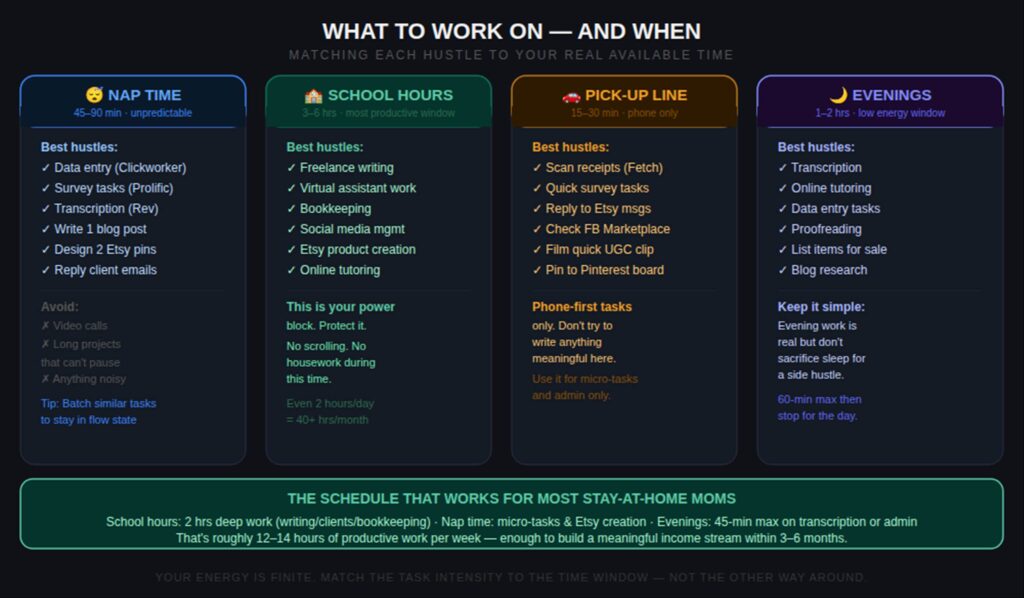
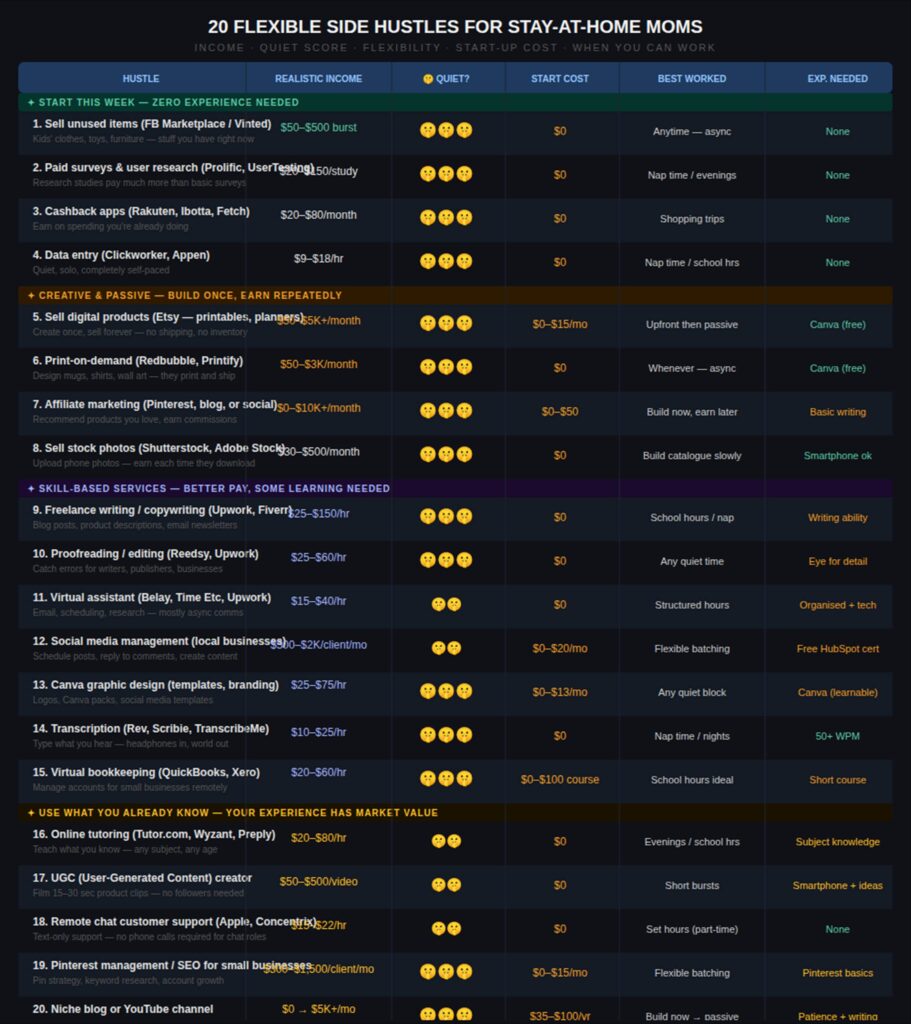
Infographic: What to work on — and when. Match each hustle to your actual available time windows.
12. Social Media Management for Local Businesses
Small businesses — salons, restaurants, physiotherapists, local shops — need a social media presence but rarely have time or knowledge to manage it themselves. If you understand how Instagram, Facebook, or Pinterest work (and most mums who use them actively do), you can offer to manage a business’s account for a monthly retainer.
A single client paying £300–£500/month for 3–4 hours of weekly work is a meaningful income. Three clients is a part-time salary. From my digital marketing studies, the gap between what small businesses need and what they have is enormous — this is genuinely a service they’ll pay for if you can show them results.
How to get your first client: approach a local business whose Instagram hasn’t posted in 3 weeks. Offer one month’s management as a free trial in exchange for a testimonial if they’re happy. Most will say yes. Most will also become paying clients.
13. Canva Graphic Design (Templates and Branding)
With Canva‘s free tier, you can produce professional-looking designs: social media graphics, logo concepts, presentation templates, media kits. Many small business owners need these but can’t afford an agency and don’t have design software themselves.
Sell your Canva template packs on Etsy (passive) or offer bespoke design work on Fiverr and Upwork (active). Either way, Canva is genuinely learnable without a design background — and the market of non-designers who need design work is enormous.
14. Transcription
Rev, Scribie, and TranscribeMe all hire remote transcriptionists. You listen to audio through headphones and type what you hear — quiet, self-paced, and completable in short sessions during nap time. Pay averages $10–$25/hr depending on your speed and accuracy.
It’s not glamorous. But for someone who types quickly and wants genuinely interruption-free work — headphones in, the world out — transcription is one of the best nap-time options on this list.
15. Virtual Bookkeeping
Small businesses need their accounts managed and the UK has a shortage of affordable, qualified bookkeepers. QuickBooks’ online training and the AAT foundation courses offer routes into this professionally. Once certified, virtual bookkeepers earn £20–£60/hr working entirely remotely with flexible hours.
This is a longer-term investment — 2–6 months of learning — but it’s one of the few side hustles that can scale into a meaningful part-time salary with a small number of steady clients.
Side Hustles That Use What You Already Know
These are options that draw on experience you already have from being a parent, from your previous career, or from skills you’ve developed outside paid work. They’re often overlooked because people underestimate the market value of what they know.
16. Online Tutoring
If you have a degree, a strong subject knowledge, or experience in teaching — even informally — online tutoring is one of the best-paying flexible options. Tutor.com, Wyzant, and Preply all connect tutors with students. Rates run from £20 to £80/hr depending on subject and level.
The scheduling is more flexible than most traditional jobs: many tutors work evenings after their own children are in bed, which suits a stay-at-home parent’s day perfectly.
17. UGC (User-Generated Content) Creator
Brands pay for authentic 15–30 second video clips of their products being used in real homes by real people. This is called UGC (user-generated content), and it’s become a significant industry. You don’t need followers or a polished aesthetic — you need a smartphone, decent lighting, and the ability to speak naturally about something you’ve tried.
Platforms like Billo, Trend, and Influee connect creators with brand campaigns. Pay per video runs from $50 to $500. A family home with a mum who actually uses baby products, household items, and food brands is exactly the demographic these brands are targeting.
Honest note: UGC is not passive — you film, edit, and deliver each video. But 30 minutes of filming for $100–$200 is a solid hourly rate that requires no followers, no niche expertise, and no formal experience.
18. Remote Chat Customer Support
Several companies — Apple, Concentrix, Sykes — hire remote chat support agents for text-based customer service. No phone calls. You type responses to customer queries from your home computer during scheduled shifts.
Pay is $15–$22/hr and shifts are often available in part-time blocks. It’s more structured than freelancing (you need to be available for agreed hours) but it’s a real job with a real wage, equipment often provided, and benefits in some cases.
- Apply at: apple.com/jobs (At Home Advisor role), concentrix.com/careers, and indeed.com filtered by “Remote” + “Chat”
19. Pinterest Management for Small Businesses
This is the one I’d specifically highlight for anyone with an interest in digital marketing — because it’s quiet, completely remote, and genuinely underserved. Most small businesses know they should be on Pinterest but have no idea how to use it effectively.
As a Pinterest manager, you research keywords, design pins in Canva, write keyword-rich descriptions, and schedule content. One client typically takes 3–4 hours of work per week for a monthly retainer of £300–£600. From my studies in digital marketing, Pinterest’s search engine model means that the work you do in month one continues ranking for years — which makes it an unusually good return on the time invested.
Your edge over agencies: you’re a real user of Pinterest. Most of your clients’ ideal customers look like you. That lived perspective is worth more than most people realise when it comes to creating pins that actually get clicked.
20. Niche Blog or YouTube Channel
I’ve left this until last because it’s the slowest to build and the most often oversold. But I’ve included it because for someone who is genuinely in the weeds of parenting right now — navigating sleep schedules, weaning, school applications, budget family meals, managing the mental load — that lived experience is exactly what other parents search for online.
A niche blog monetised with Mediavine or AdThrive and affiliate links can earn £500–£5,000+/month from content you wrote months or years earlier. The same content on YouTube earns through AdSense, sponsorships, and product recommendations.
But I want to be clear: this takes 12–24 months of consistent effort before meaningful income arrives. It is not a solution to a financial need this month. It is a long-term asset that stays-at-home mums are particularly well-placed to build — because the content they’re writing draws from their actual daily life.
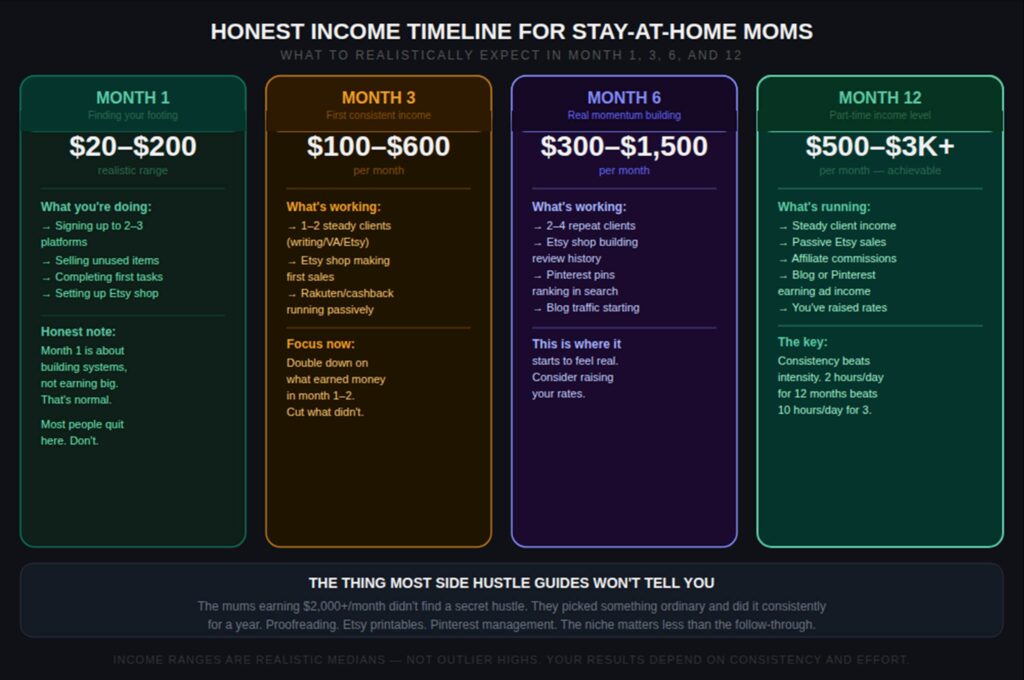
Infographic: Honest income timeline — what to realistically expect in months 1, 3, 6, and 12
How to Choose — An Honest Framework
The question isn’t “which side hustle pays the most?” It’s “which one can I actually fit into my life right now and stick with for six months?”
Here’s how I’d think about it:
- Need money this week: Sell unused items on Facebook Marketplace or Vinted. List ten things today.
- Have nap time (45–90 mins) daily: Clickworker for data entry or Rev for transcription. Quiet, self-paced, earns within days.
- Have 2+ school hours daily: Freelance writing, VA work, or bookkeeping. Invest this time in a skill with a longer payoff.
- Want passive income long-term: Etsy digital products or Pinterest affiliate marketing. Build during school hours, earn while you sleep.
- Have a subject specialism: Tutoring. £30–£80/hr working evenings.
- Confident on camera: UGC creation. $100–$300 per short video, no followers required.
Honest note: One thing I’d say from studying this: the mums who make real income from side hustles pick one thing and stay with it for six months. The ones who switch every few weeks because “it’s not working yet” are usually three months away from the inflection point they’ll never reach.
Frequently Asked Questions
Can I really earn money while my baby sleeps?
Yes — but the honest answer is that nap times are best used for low-intensity, interruptible tasks. Data entry on Clickworker, Prolific surveys, scanning receipts with Fetch, or pinning on Pinterest are all realistic nap-time activities. Freelance writing or client work is better saved for a longer, more reliable block like school hours.
Which side hustle is best if I have no skills or experience?
Selling unused items is the fastest way to earn with zero skills — you have the products, you list them, people buy them. After that, data entry on Clickworker requires no prior experience and gets you earning within 48 hours. Cashback apps require no effort at all. These three together can generate £50–£150 in your first two weeks.
Are there any scams I should watch out for?
Yes — the data entry and survey space specifically attracts scam listings. Red flags: any listing that asks you to pay upfront for “training” or “equipment,” promises $50+/hr for basic tasks, contacts you via WhatsApp or personal email, or offers an instant job with no interview. Every legitimate platform on this list is free to join. When in doubt, search “[platform name] + scam + Reddit” before signing up.
Do I need to declare side hustle income for tax?
In the UK, you can earn up to £1,000 per tax year from self-employment without needing to declare it under the Trading Allowance. Above that, you’ll need to complete a Self Assessment. In the US, all self-employment income is taxable and most platforms issue a 1099-K above $600. Keep records from the start and set aside 20–25% of earnings. When in doubt, check HMRC guidance or consult a qualified accountant.
What if I only have 30 minutes a day?
Thirty minutes a day is 182 hours a year. That’s genuinely enough to build something — just not quickly. With 30 minutes daily, I’d focus on Etsy digital product creation or Prolific surveys for the first two months, then gradually redirect that time toward a higher-earning skill once the habit is established. Small, consistent windows beat occasional marathon sessions every time.
The Bottom Line
Staying at home isn’t a gap in a CV. It’s evidence of project management, time optimisation, budget management, and an intimate understanding of what other parents are searching for online. Those are genuine, marketable assets.
The side hustles on this list work best when they draw from that lived experience — not despite your situation, but because of it. A parenting blog, an Etsy planner shop, a Pinterest account recommending the baby products you’ve actually tested: these work because they’re real.
Start with whatever you can do this week. Do it consistently. And give it longer than feels comfortable before deciding it isn’t working.