40 Passive Income Ideas for Beginners That Make Money While You Sleep
Table Of Contents
The Short Answer: The best passive income ideas for beginners in 2025 are affiliate marketing, selling digital products, print-on-demand, high-yield savings accounts, and dividend ETFs — all of which require little to no upfront investment. With consistent effort over 3–6 months, beginners can realistically earn $200–$1,000/month from their first income stream.
The Truth About Passive Income
Let’s be upfront: “passive” income almost never starts passive. Every income stream on this list requires real upfront work — creating, investing, building, or setting up. The “passive” part comes later, when the work you’ve done continues to pay you without ongoing effort.
But here’s the exciting part: once that flywheel starts spinning, it genuinely does earn money while you sleep. According to Bankrate, nearly 45% of Americans have a side hustle in 2025 — and the smartest ones are pivoting from trading time for money to building assets that generate recurring income.
This guide covers all 40 ideas, ranked and explained — from things you can start today with zero money, to longer-term plays that could replace your full salary.
All 40 Ideas at a Glance
Here’s every idea with startup cost, earning potential, and time to first income. We’ll cover each in detail below.
| # | Idea | Category | Startup Cost | Earning Potential | Time to First $ |
| 1 | Affiliate marketing (blog) | Digital | $0–$100 | $0–$10k+/mo | 3–12 months |
| 2 | Affiliate marketing (YouTube) | Digital | $0–$300 | $0–$8k+/mo | 6–18 months |
| 3 | Selling digital products (Etsy) | Digital | $0 | $100–$5k/mo | 1–3 months |
| 4 | Selling digital products (Gumroad) | Digital | $0 | $100–$5k/mo | 1–3 months |
| 5 | Print-on-demand (Redbubble) | Digital | $0 | $50–$3k/mo | 2–6 months |
| 6 | Print-on-demand (Printful+Etsy) | Digital | $0 | $100–$5k/mo | 2–6 months |
| 7 | eBook publishing (Amazon KDP) | Digital | $0–$50 | $50–$2.5k/mo | 1–6 months |
| 8 | Online course (Udemy) | Digital | $0–$200 | $200–$10k+/mo | 1–3 months |
| 9 | Online course (Teachable/Kajabi) | Digital | $29–$119/mo | $500–$10k+/mo | 2–6 months |
| 10 | Canva template shop | Digital | $0–$15/mo | $50–$4k/mo | 2–6 months |
| 11 | Notion/Excel template store | Digital | $0 | $30–$2k/mo | 1–3 months |
| 12 | Stock photography (Shutterstock) | Digital | $0 | $30–$2k/mo | 3–12 months |
| 13 | Stock video (Adobe Stock) | Digital | $0 | $50–$3k/mo | 3–12 months |
| 14 | YouTube channel (AdSense) | Digital | $0–$200 | $0–$10k+/mo | 6–18 months |
| 15 | Niche blog (Mediavine/AdThrive) | Digital | $50–$200/yr | $50–$8k/mo | 6–24 months |
| 16 | Newsletter sponsorships | Digital | $0 | $100–$5k/mo | 6–18 months |
| 17 | Podcast ad revenue | Digital | $0–$200 | $50–$5k/mo | 6–18 months |
| 18 | License your music (DistroKid) | Creative | $20/yr | $30–$2.5k/mo | 6–18 months |
| 19 | Sell AI art / prompts | Creative | $0 | $50–$1k/mo | 1–3 months |
| 20 | Dropshipping store | eCommerce | $0–$300 | $100–$6k/mo | 2–6 months |
| 21 | Amazon FBA | eCommerce | $500–$2k | $200–$10k+/mo | 3–12 months |
| 22 | Merch by Amazon | eCommerce | $0 | $50–$3k/mo | 2–6 months |
| 23 | Flip domain names | Online | $10–$500 | $50–$5k/mo | Variable |
| 24 | Sell website (Flippa) | Online | $100–$5k | $1k–$50k (lump) | Variable |
| 25 | Peer-to-peer lending (Prosper) | Investing | $25+ | $50–$2k/mo | Immediate |
| 26 | Dividend stocks / ETFs | Investing | $100+ | $50–$4k/mo | Immediate |
| 27 | REITs | Investing | $10+ | $50–$3k/mo | Immediate |
| 28 | High-yield savings account | Investing | $1+ | $30–$1.5k/mo | Immediate |
| 29 | Bonds / T-bills | Investing | $100+ | $30–$1k/mo | Immediate |
| 30 | Rental property | Real Estate | $10k+ | $200–$8k/mo | 1–6 months |
| 31 | Rent room on Airbnb | Real Estate | $0–$500 | $300–$3k/mo | 1–4 weeks |
| 32 | Rent storage space (Neighbor) | Real Estate | $0 | $50–$500/mo | 1–4 weeks |
| 33 | Rent your car (Turo) | Assets | $0 | $100–$3k/mo | 1–2 weeks |
| 34 | Rent camera gear (Fat Llama) | Assets | $0 | $50–$1k/mo | 1–2 weeks |
| 35 | Rent driveway / parking | Assets | $0 | $50–$500/mo | 1–2 weeks |
| 36 | License your photos (Getty) | Creative | $0 | $100–$3k/mo | 1–6 months |
| 37 | Cashback / rewards apps | Apps | $0 | $10–$200/mo | Immediate |
| 38 | Index fund investing | Investing | $1+ | $50–$5k/mo | Long-term |
| 39 | Build and sell a micro-SaaS | Tech | $0–$500 | $500–$10k+/mo | 3–12 months |
| 40 | Licensing intellectual property | Creative | Varies | $100–$10k+/mo | Variable |
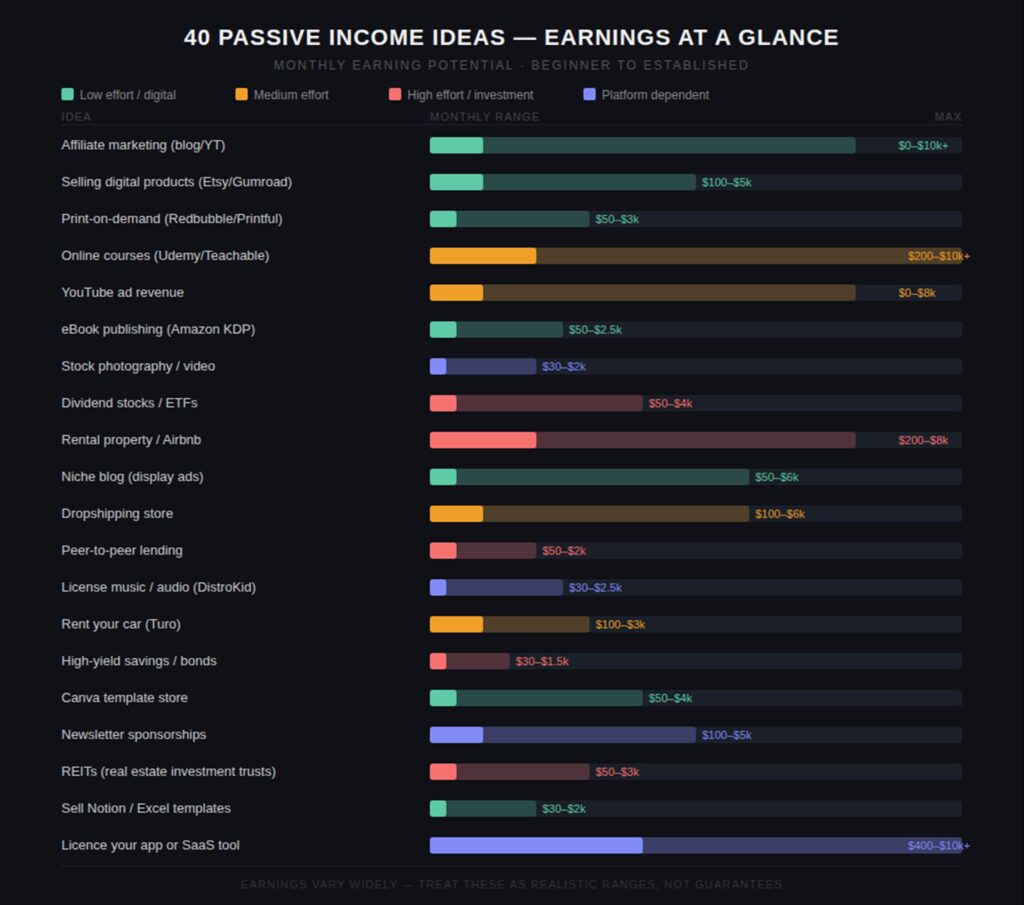
Infographic: Earning potential comparison across 20 top passive income ideas
Part 1: Digital Passive Income (The Best for Beginners)
Digital income streams are the single best starting point for most beginners. Why? Zero inventory, zero shipping, and your products can sell to anyone on earth at 3am without you lifting a finger. Here are the 19 best digital passive income ideas.
1. Affiliate Marketing (Blog)
✍ AUTHOR NOTE: [PERSONAL EXPERIENCE: Share your affiliate earnings, which programs you use, and how long it took to see results.]
Affiliate marketing is consistently ranked the #1 beginner passive income method. You write content, recommend products, embed a link, and earn a commission every time someone buys. The top programs — Amazon Associates, ShareASale, and Impact — are all free to join.
What you need to start: A blog (WordPress + Bluehost costs around $35/year), a niche, and 20–30 SEO-optimised posts.
Realistic timeline: 3–12 months to first commission. 12–24 months to consistent income.
Earning potential: $0–$10,000+/month depending on niche and traffic. Finance, tech, and health niches pay the most.
- Pro tip: Focus on product review and comparison posts — they have the highest buying intent.
- Best for: Writers, bloggers, people who love a specific niche topic.
2. Affiliate Marketing (YouTube)
The same principle as blog affiliate marketing, but via video. YouTube’s search engine is the world’s second largest, and well-optimised videos rank for years. Include affiliate links in your description and earn every time a viewer buys.
You don’t need expensive gear — many successful affiliate YouTube channels are built on a smartphone. VidIQ and TubeBuddy are essential free tools for keyword research.
3. Selling Digital Products on Etsy
Etsy isn’t just for handmade crafts. It’s one of the biggest marketplaces for digital downloads: planners, printables, templates, invitations, spreadsheets, and more. You create the file once and it sells forever.
Best-selling digital product categories on Etsy: Budget planners, wedding invitation templates, resume templates, Canva social media packs, and kids’ activity printables.
eRank is the go-to free tool for Etsy keyword research — use it to find what’s selling before you create.
- Startup cost: $0. Etsy charges $0.20 per listing and takes 6.5% per sale.
- Earning potential: $100–$5,000+/month for a well-stocked shop with good SEO.
4. Selling Digital Products on Gumroad
Gumroad is simpler than Etsy and great for selling directly to your audience. It handles payments, delivery, and customer emails automatically. Ideal for eBooks, templates, preset packs, and courses.
Key advantage over Etsy: You keep more of the revenue (Gumroad takes 10%), and you own your customer list.
5–6. Print-on-Demand
Print-on-demand (POD) lets you sell custom-designed products — t-shirts, mugs, phone cases, wall art — without ever touching inventory. When someone orders, the POD company prints and ships it for you.
Best platforms: Redbubble (marketplace, built-in traffic), Printful (integrates with your own store), Printify, and Merch by Amazon.
Use Canva to create designs — no design experience needed. Focus on niches: dog mums, teachers, specific hobbies, professions, or fandoms (within copyright rules).
- Startup cost: $0 on Redbubble. Merch by Amazon is invite-only but worth applying.
- Earning potential: $50–$5,000/month for a portfolio of 100+ designs across multiple niches.
7. eBook Publishing on Amazon KDP
Amazon KDP (Kindle Direct Publishing) lets you self-publish eBooks and paperbacks for free. You keep 35–70% royalties on every sale. Low-content books (journals, planners, puzzle books) are particularly beginner-friendly because they require minimal writing.
- Quickest win: Publish a niche journal or planner using a free KDP interior template.
- Earning potential: $50–$2,500+/month for a catalogue of 10+ books.
8–9. Online Courses
If you have any expertise — cooking, coding, marketing, language learning, fitness — you can package it into a course and sell it forever. The e-learning market is projected to exceed $1 trillion by 2032.
Best platforms: Udemy (built-in marketplace, lower prices), Teachable and Kajabi (your own brand, higher margins), Thinkific (free plan available).
The golden rule: Sell the course before you build it. Run a presale or waitlist to validate demand before investing time in creation.
- Earning potential: $200–$10,000+/month. A single evergreen Udemy course can earn for years.
10. Canva Template Shop
With Canva Pro ($13/mo), you can create stunning templates — social media packs, pitch decks, menus, media kits — and sell them on Etsy, Creative Market, or your own website. The demand for done-for-you Canva templates is enormous among small business owners who can’t design.
11. Notion / Excel Template Store
Templates for productivity tools like Notion have exploded in popularity. Budget trackers, project managers, habit systems, and content calendars sell well on Etsy and Gumroad. One creator famously generated nearly $300,000 in two years selling Google Sheets templates on Etsy.
12–13. Stock Photography and Video
Every blog post, ad, and website needs images. Upload your photos and videos to Shutterstock, Adobe Stock, and iStock and earn royalties every time they’re downloaded. Shutterstock reported revenues of $267 million in Q2 2025 alone — that money comes from contributors like you.
What sells: Business scenarios, diverse people, food close-ups, travel destinations, and editorial shots of trending topics.
14. YouTube Channel
A YouTube channel earns through AdSense ($3–$5 per 1,000 views), sponsorships, affiliate links, and merchandise. The key is evergreen content — tutorials, how-tos, and explainers that get searched and watched for years after publication.
Use TubeBuddy for keyword research, aim for 1,000 subscribers and 4,000 watch hours to qualify for monetisation. Consistency over 12 months is non-negotiable.
15. Niche Blog with Display Ads
A niche authority blog — covering one topic exhaustively — can qualify for Mediavine or AdThrive, which pay $15–$50+ per 1,000 pageviews. That’s $750–$2,500/month on 50,000 monthly visitors.
SEO tools to use: Ahrefs or Ubersuggest for keyword research. Focus on long-tail, low-competition keywords first.
16–17. Newsletter and Podcast Sponsorships
Build an email list through your blog or social media and monetise it with sponsored placements. Beehiiv and ConvertKit make it easy to launch a newsletter. Once you have 1,000+ engaged subscribers, brands will pay $50–$500+ per mention.
Similarly, a podcast with Buzzsprout or Anchor can earn through host-read ads, affiliate recommendations, and listener memberships via Patreon.
18–19. Music Licensing and AI Art
If you create music, upload it to DistroKid ($22/year) and earn streaming royalties from Spotify, Apple Music, and 150+ platforms. Alternatively, license your tracks to YouTube creators via Musicbed or Artlist.
AI-generated art and prompt packs are newer but growing. Sell on Etsy, PromptBase, or via your own Gumroad store. Check platform terms carefully as policies evolve.
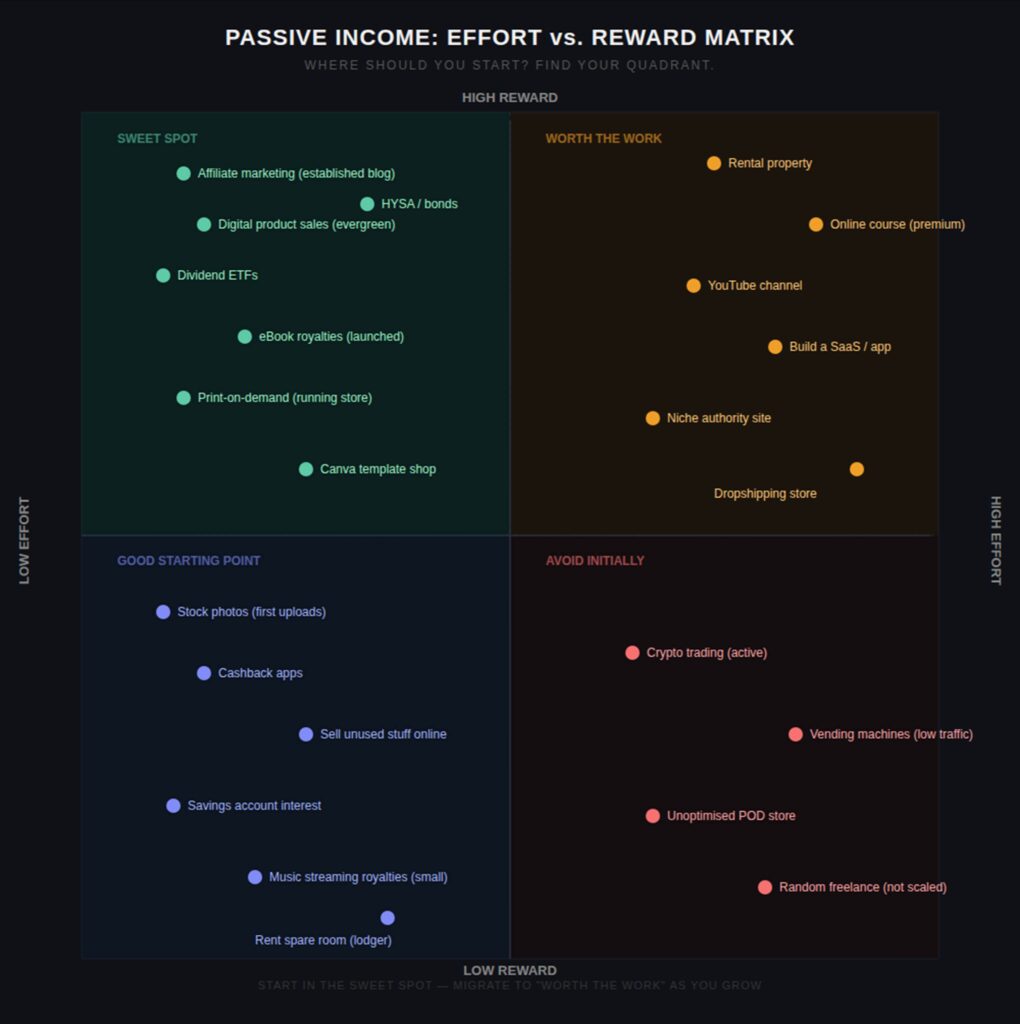
Infographic: Effort vs. Reward matrix — where to start and where to grow
Part 2: eCommerce Passive Income
20. Dropshipping
Dropshipping lets you sell physical products online without holding inventory. When a customer orders from your Shopify or WooCommerce store, your supplier ships directly to them. Tools like DSers and Spocket automate the fulfilment side.
The catch: Dropshipping is competitive and margins are thin. Winning stores either target a very specific niche or sell high-margin products (>$50 per item).
- Startup cost: $0–$300 (Shopify $29/mo + ads budget)
- Earning potential: $100–$6,000+/month for a profitable niche store
21. Amazon FBA
FBA (Fulfilment by Amazon) lets you source products — often from Alibaba — and sell them on Amazon with Amazon handling all storage, shipping, and returns. Jungle Scout is the go-to tool for product research.
Warning: Amazon FBA has the highest startup cost on this list ($500–$2,000 minimum). Don’t start here unless you have capital and can afford to lose your first investment.
22. Merch by Amazon
Merch by Amazon is Amazon’s print-on-demand programme — you upload designs, Amazon handles production, fulfilment, and customer service. It’s invite-only but worth applying. Lower risk than FBA with no upfront investment.
23–24. Domain Flipping and Selling Websites
Buy expired or undervalued domain names and sell them for profit on Sedo or Afternic. Alternatively, build a niche website to a point of generating ad income, then sell it for 30–40x monthly revenue on Flippa or Empire Flippers. A blog earning $500/month could sell for $15,000–$20,000.
Part 3: Investing-Based Passive Income
✍ AUTHOR NOTE: [DISCLAIMER: I am not a financial advisor. The below is for informational purposes only. Always do your own research or consult a qualified financial professional before investing.]
25. Peer-to-Peer Lending
Platforms like Prosper and LendingClub let you lend money to individuals and earn interest. Returns typically range from 5–10% annually, though there’s credit risk involved. Start with small amounts spread across many loans to diversify.
26. Dividend Stocks and ETFs
Dividend-paying companies distribute a portion of profits to shareholders quarterly. Starting with broad market ETFs like Vanguard’s VYM or SCHD gives instant diversification. Reinvesting dividends (DRIP) accelerates compounding significantly.
- Realistic yield: 3–6% annually on a diversified dividend portfolio
- On $10,000: $300–$600/year ($25–$50/month)
- On $100,000: $3,000–$6,000/year ($250–$500/month)
27. REITs (Real Estate Investment Trusts)
REITs let you invest in real estate portfolios without buying property. They’re required by law to distribute 90% of taxable income to shareholders. Available through any standard brokerage account — Fidelity, Schwab, or Interactive Brokers.
28–29. High-Yield Savings Accounts and Bonds
With interest rates still elevated in 2025, high-yield savings accounts (HYSA) pay 4–5% APY — significantly better than the 0.01% offered by traditional banks. Marcus by Goldman Sachs, Ally Bank, and SoFi consistently offer competitive rates.
US Treasury bills (T-bills) and I-bonds are government-backed with no credit risk. UK readers can use Premium Bonds or Vanguard UK for similar low-risk options.
38. Index Fund Investing
The most proven long-term wealth builder. Low-cost index funds (S&P 500, total world market) consistently outperform actively managed funds over the long term. Start with Vanguard, Fidelity’s FZROX (0% expense ratio), or iShares. For UK investors: InvestEngine or Moneybox.
Part 4: Rent Your Assets
30–31. Rental Property and Airbnb
Traditional rental property remains the highest-earning passive income on this list, but also requires the most capital. A better starting point is renting a spare room on Airbnb or Vrbo — no mortgage or purchase required.
Average Airbnb host earnings: $924/month, according to Airbnb’s own data. Earnings vary enormously by location, seasonality, and how well you optimise your listing.
32. Rent Storage Space
Neighbor.com lets you rent unused space — a garage, basement, driveway, or spare room — as storage to local renters. Hosts earn $100–$500/month depending on space and location with minimal effort after listing.
33. Rent Your Car on Turo
Turo is the Airbnb of cars. List your car when you’re not using it and earn $300–$1,000+/month depending on your vehicle and location. Turo provides insurance during rentals. Most profitable: pickup trucks, SUVs, and electric vehicles in urban areas.
34–35. Rent Camera Gear and Parking
Fat Llama and KitSplit let you rent out cameras, lenses, and audio gear to local filmmakers. JustPark and SpotHero let you monetise a private driveway or parking space. Small streams, but zero ongoing work once listed.
Part 5: Creative and Tech Passive Income
36. License Your Photography (Getty)
Beyond Shutterstock, Getty Images pays higher per-download royalties for contributors who meet their quality standards. Focus on editorial photography — news events, cultural moments, local scenes that businesses and media organisations pay premium prices to license.
37. Cashback and Rewards Apps
Not glamorous, but genuinely passive. Rakuten, TopCashback, and Honey automatically give you cash back on purchases you’d make anyway. Stack with a rewards credit card for double-dipping. Realistic earnings: $100–$200/year, not $200/month — but the effort is literally zero.
39. Build a Micro-SaaS
A micro-SaaS is a small, targeted software tool that solves one specific problem and charges a monthly subscription. Examples: a niche spreadsheet calculator, a specific automation tool, a simple API. Build with no-code tools like Bubble, Glide, or Webflow.
The dream: 100 customers at $29/month = $2,900/month. More realistic starting target: 10 customers at $19/month = $190/month with minimal maintenance.
40. Licensing Intellectual Property
If you’ve created anything — a process, a framework, a brand name, a unique methodology — it can potentially be licensed to others for a fee. This is advanced territory but worth knowing: patents, trademarks, and copyrights are all assets that can generate royalty income. Contact LegalZoom or a local IP attorney to explore options.
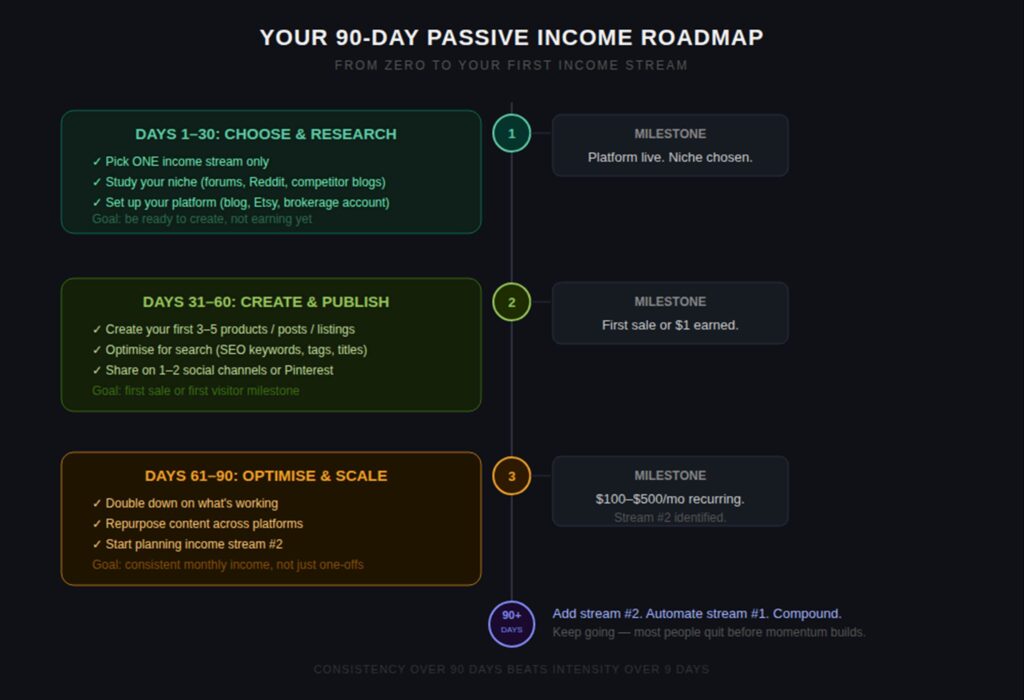
Infographic: Your 90-day passive income roadmap
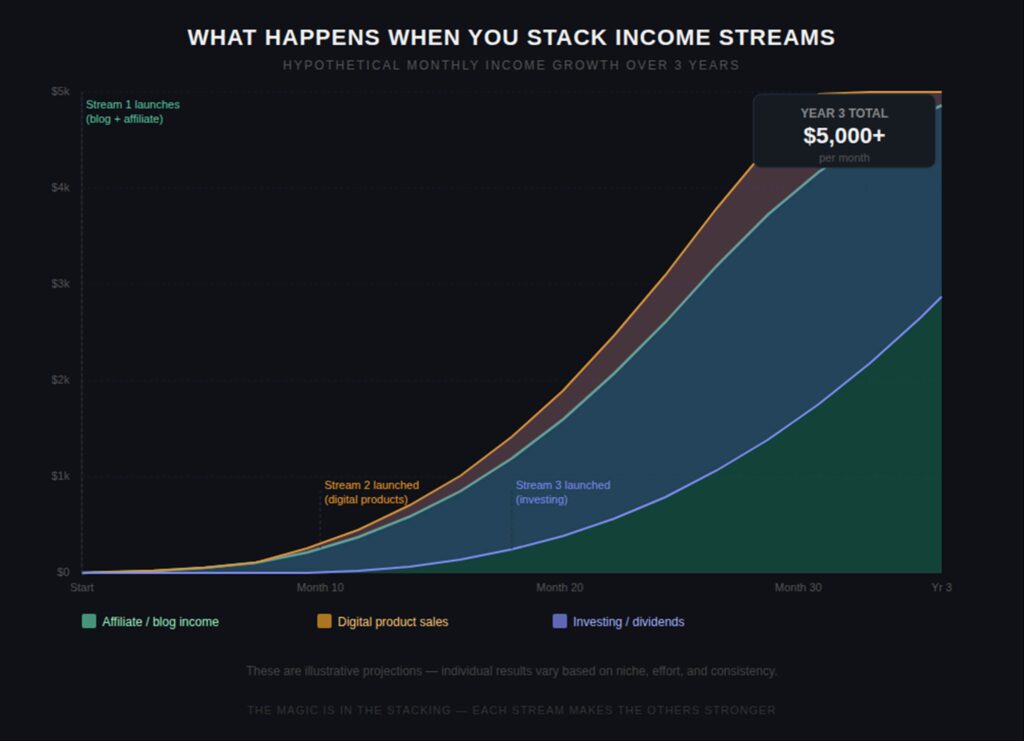
Infographic: What happens when you stack multiple income streams over 3 years
How to Choose Your First Passive Income Stream
With 40 options, the biggest mistake is trying too many at once. Here’s a simple framework to pick the right one for you:
- Match your skills. A writer should start with a blog or eBooks. A designer should start with templates or POD. A photographer should start with stock photos. Playing to your strengths cuts the learning curve in half.
- Assess your starting budget. If you have $0, start with Etsy digital products, a blog, or stock photos. If you have $1,000+, dividend ETFs or a Shopify store give you more options.
- Consider your time commitment. A blog requires 6–12 months of consistent content before meaningful income. Renting your car on Turo can generate income within two weeks.
- Pick ONE and go deep. Resist the temptation to run three streams at once. Most people fail at passive income not because their idea was bad, but because they spread themselves too thin and never built momentum in any single direction.
The Rule of One: commit to a single income stream for 90 days before evaluating whether it’s working. Most people quit at day 45 — just before the growth inflection point.
5 Mistakes Beginners Make With Passive Income
- Expecting fast results. Most passive income streams take 6–18 months to generate meaningful returns. If you start expecting income in week 2, you’ll quit in month 3.
- Chasing the highest earner. The top 5% of Etsy shops, YouTubers, and bloggers skew the average numbers heavily. Start with realistic expectations: $200–$500/month in year one is a genuine win.
- Not tracking anything. Without measuring what’s working (traffic, conversion rates, revenue per stream), you’re flying blind. Use a simple spreadsheet to track monthly progress.
- Building before validating. Before spending 40 hours creating a course or 100 hours building a blog, validate demand. Check search volume, check Etsy competition, ask your audience.
- Giving up before the compounding kicks in. The growth curve for most passive income streams is flat for months, then exponential. The people who win are the ones who are still there when the hockey stick begins.
Frequently Asked Questions
What is the easiest passive income for a beginner?
The easiest passive income for beginners with no upfront investment is selling digital products on Etsy or Gumroad. You can create a simple printable planner or Canva template in a few hours, list it for free, and start making sales within days. The key is to research what’s already selling before you create.
How much money do you need to start passive income?
Many passive income streams — affiliate marketing, digital products, print-on-demand, stock photography — require $0 upfront. Investing-based streams (dividend stocks, REITs, HYSA) can start with as little as $1. Only Amazon FBA and rental property require significant capital ($500–$10,000+).
How long does it take to earn passive income?
Asset rental (Turo, Airbnb, parking) can generate income within 1–2 weeks. Investing can generate income immediately. Digital products can sell within days but typically take 2–6 months to generate consistent income. Blogs and YouTube channels typically take 6–18 months before meaningful revenue.
Is passive income taxable?
Yes — in virtually all jurisdictions, passive income is taxable. In the US, most passive income is treated as ordinary income or capital gains depending on the type. In the UK, trading income, rental income, and investment income all have specific tax rules. Consult a qualified accountant or HMRC’s guidance or the IRS website for your specific situation.
What passive income is most reliable?
High-yield savings accounts, government bonds, and dividend ETFs from established companies are the most reliable because they’re backed by assets or government guarantees. Digital income (blogs, courses, products) is less reliable because it depends on algorithms and platform changes, but the upside is much higher.
Can you really make money while you sleep?
Yes — but only after substantial upfront work. A blog post published today can earn affiliate commissions 3 years from now. A digital product listed on Etsy can sell at 4am while you’re asleep. An ETF holding dividend stocks pays you quarterly regardless of what you’re doing. The “passive” part is real — but so is the required setup work.
What passive income is best for students?
For students with limited capital and time, the best options are: (1) digital products on Etsy — create during a free weekend, earn for years; (2) affiliate marketing — build a blog or YouTube channel around your area of study; (3) stock photography — monetise photos you’d take anyway; (4) high-yield savings account — put student loan surplus in a HYSA rather than a current account.
How do I start affiliate marketing with no money?
Start a free blog on WordPress.com or Medium (though a self-hosted WordPress blog on Bluehost at $35/year is much more effective), join Amazon Associates (free), and write honest reviews of products in your niche. It costs nothing except time, and if you publish consistently for 12 months, you will see results.
The Bottom Line
Passive income isn’t a shortcut — it’s a trade. You trade effort now for freedom later. The 40 ideas in this guide span every budget, skill level, and time horizon. Some will suit you perfectly; others won’t be right for your situation at all.
The most important thing you can do today is pick one idea, commit to 90 days, and start. Not next month, not after you’ve read another guide. Today.
Track your progress, learn from what doesn’t work, double down on what does, and remember: every passive income success story started with someone who decided to begin.